Full mouth dental implants may be considered when many teeth are missing, severely damaged, or unlikely to be restored predictably. The phrase can describe treatment for one jaw or both; it does not name one standard operation. A helpful consultation maps your needs to possible care: which teeth may be retained, what replacement designs are realistic, what steps may be involved, and how a result can be maintained.
Request a specialist consultation
Some people need replacement of all teeth in one jaw; others need care in both jaws. A full-arch restoration may attach to implants, while another person may be better served by retaining some teeth, individual restorations, or a removable option. The number and placement of implants, whether any teeth can be preserved, and the design of replacement teeth depend on examination and planning.
Implants are placed in the jaw and can support replacement teeth, but the phrase “full mouth” does not tell you whether the plan is fixed or removable, how many appointments it involves, or whether preparatory care is needed. Review the practice's dental implant services, the distinct All-on-4 treatment approach, and options for dentures and implant dentures. These pages describe options to discuss, not a diagnosis for your situation.
It also helps to distinguish replacing teeth from rebuilding the way the teeth meet. If worn, broken, or missing teeth have changed your bite, the clinician may consider how several restorations work together. A broader full-mouth reconstruction evaluation may organize questions about teeth, implants, and restorations in both jaws.
The first step is to understand the whole clinical picture, not simply count missing teeth. The clinician reviews your medical and dental history, symptoms, current restorations, and priorities. An examination and appropriate imaging help assess teeth, gums, bite, and jaw anatomy. Findings inform whether teeth may be preserved, whether implants may be appropriate, and whether preparatory steps could be needed.

Planning also needs to account for how replacement teeth may look and function, how the bite distributes forces, and how the restoration can be cleaned. Tell the clinician what matters most: appearance, speech, comfort, treatment time, or ease of home care. If you have trouble cleaning certain areas now, explain where and why. That detail can guide a practical conversation about restoration shape and access.
Bring a current medication list and relevant health information. If you have prior dental records or images, ask whether they would be useful. Share past experiences with dental treatment and any difficulty keeping appointments, since these details can affect planning and support. A clear account of your priorities can be more useful than arriving with a fixed procedure in mind. The doctors' profiles can help you learn about the clinicians before your visit.
A finding on an image is only one part of a decision. Ask the specialist to explain what the image does and does not show, how it relates to your examination, and whether additional information is needed before a recommendation is made. General population-level data cannot answer those questions for an individual. For example, the Oral Health Foundation's global oral health statistics overview discusses untreated tooth decay at a population level; it does not establish whether implants are suitable for a particular person.
There is no single sequence for everyone. Depending on the findings and restoration design, treatment may involve some or all of these stages:
Ask what each phase is intended to accomplish and what would prompt a change. Some patients may receive a temporary restoration soon after surgery, while others need a different timeline. Do not assume a same-day temporary is suitable in every situation. Ask how it will be supported, what foods or activities to avoid, how adjustments will be handled, and whom to contact if it feels uncomfortable.
A useful written plan names the expected stages without presenting estimates as promises. For example, a plan might separate diagnostic visits, any needed preparation, surgery, a temporary phase, delivery of the final restoration, and follow-up. For each stage, ask what must be assessed before the next one begins. If a step depends on healing or another clinical finding, ask how that decision will be made and how you will be notified.
Options differ in support, removability, cleaning, and the treatment needed to provide them. Use this table as a discussion aid, not an individualized recommendation.
| Option | How it is supported | Questions to discuss |
|---|---|---|
| Removable complete denture | Rests on oral tissues and is removed for cleaning | How might fit, stability, and adjustments be managed? |
| Implant-retained removable restoration | Attaches to implants but is removed by the patient for care | What attachment system, cleaning routine, and maintenance are expected? |
| Fixed implant-supported full-arch restoration | Secured to implants and removed by a clinician for service | How will cleaning access, repairs, and future service be handled? |
| Individual tooth replacement plan | May combine implants, crowns, bridges, or retained teeth | Which teeth can be preserved, and how does the bite affect the plan? |
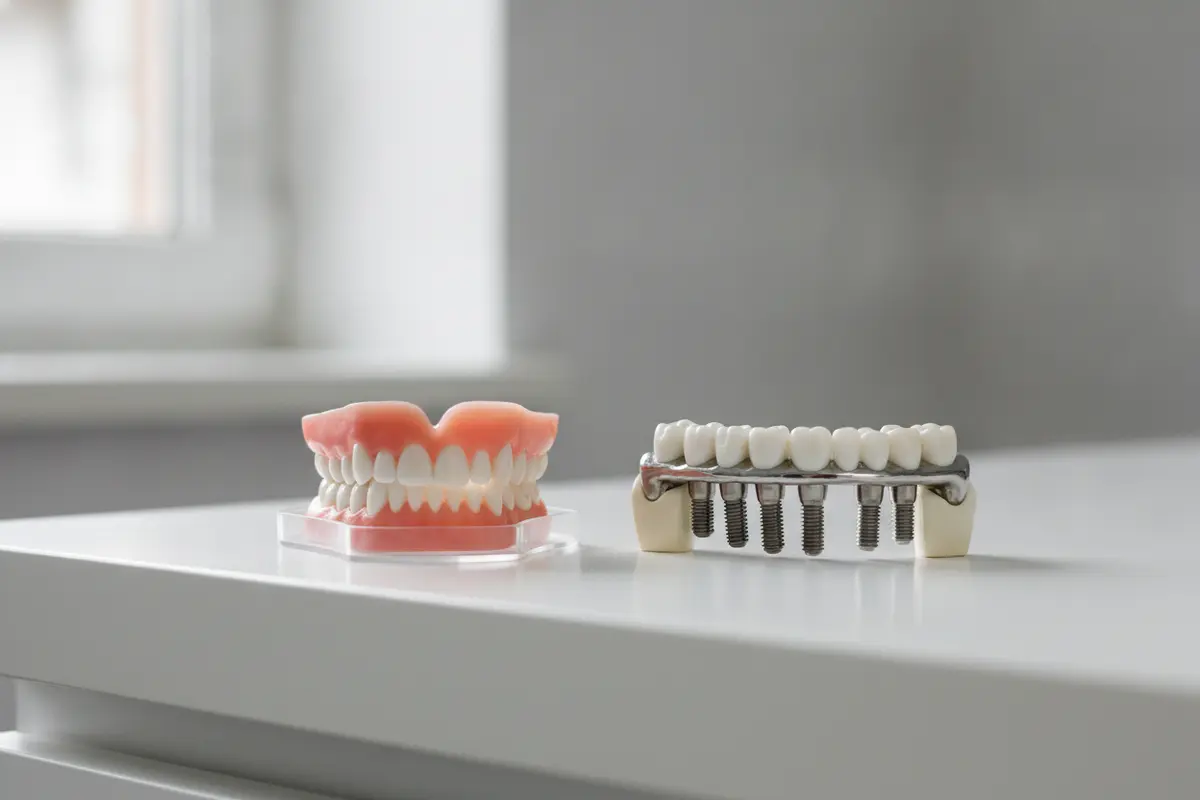
A fixed restoration is not automatically the best choice for every person. Anatomy, health, restorative design, cleaning ability, and preferences all matter. Ask what the clinician recommends and why, what alternatives are feasible, and how each option may affect daily care and future service. A useful comparison considers more than whether teeth are fixed or removable: ask how many visits may be involved, whether temporary teeth are planned, what maintenance appointments are expected, and who will adjust or repair the restoration.
For example, someone who values a restoration that stays in place may focus on a fixed design, but should also understand cleaning access and clinician service. Someone who prefers to remove teeth for daily cleaning may want to ask about implant-retained removable designs and attachment upkeep. Neither example determines suitability; it shows why personal priorities need to be considered alongside examination findings.
Consider comparing each option with the same short checklist. What supports it? Can you remove it yourself? What does daily cleaning involve? What professional maintenance may be needed? What happens if a part loosens, chips, or stops fitting comfortably? A written answer for each design makes it easier to compare the real care responsibilities rather than just the names of procedures.
Timeframes vary because treatment may depend on healing, the condition of existing teeth, jaw anatomy, and whether preparatory care is needed. Some cases can be coordinated in fewer visits, while other cases need staged care. Ask for a proposed sequence and the reason for each stage rather than relying on a general timetable. You can also ask which appointments require your presence and whether any stage is conditional.
Clarify what is planned for the period between surgery and final teeth. If a temporary restoration is included, ask how it will be supported and adjusted, what foods or activities to avoid, and whom to contact if it feels uncomfortable or changes your bite. Follow the treating team's instructions, which depend on your procedure and health. If a temporary is not planned, ask what arrangement will be used during healing and what limitations to expect.
Healing is not a calendar promise. A clinician may need to reassess before moving to the next stage. Ask what signs or findings will guide that decision, what follow-up visits are anticipated, and what happens if healing takes longer than expected. Knowing how schedule changes are handled can make planning work, travel, and support at home easier.
Before committing to a schedule, make a simple personal plan. Identify who can accompany you if needed, how you will manage work or caregiving around appointments, and what questions you need answered about temporary teeth. Ask the practice to distinguish expected milestones from dates that depend on clinical review. That distinction helps you plan without treating an estimated timeline as a guarantee.
If a proposed timeline sounds very different from another plan you have received, compare the assumptions rather than deciding from the number of weeks alone. Ask whether each plan includes the same stages, temporary restoration, healing checks, and final fitting. The clinicians may be responding to different examination findings or recommending different sequences. Understanding the reason for a difference is more useful than treating one timetable as universally correct.
Explore dental implant treatment options
When comparing two opinions, use the same questions for both. Request a written outline of the diagnosis, sequence, type of restoration, maintenance needs, and services included. If one plan proposes removing teeth and another proposes retaining some, ask each clinician to explain the reasoning. The goal is not to compare only implant count; it is to understand what each plan is designed to achieve and what care it requires.
Financial details also deserve clear questions. Ask whether an estimate separates planning, surgery, provisional teeth, final restoration, and maintenance, and what might be billed separately. The practice provides information about financing and insurance considerations; confirm current terms directly with the office and any financing provider. Do not assume a benefit estimate is a guarantee of payment. If you compare estimates, check that they describe the same treatment scope and identify what is not included.
You may also want to clarify who coordinates the different parts of care and where you should direct questions after a visit. The practice describes its approach and practice information; ask the team to explain how your own care would be organized. If you are researching the practice, its broader service list can help you locate related areas to ask about.
To make a consultation productive, group questions by decision. First, clarify diagnosis and which teeth may remain. Next, compare realistic restoration designs and their care requirements. Then discuss sequence, temporary teeth, follow-up, and financial details. If an answer uses unfamiliar terms, ask for a plain-language explanation or a written summary. You do not need to decide during the first conversation.
Before the visit, rank the things that matter most to you. A short list might include stable chewing, speech, appearance, avoiding removable teeth, ease of cleaning, or keeping treatment stages manageable. Mark which preferences are essential and which are flexible. This helps the clinician explain trade-offs instead of assuming every patient wants the same result.
Consider a person who has several failing teeth and a denture that moves during meals. The key questions may include whether any teeth can be saved, whether a removable or fixed design is feasible, what temporary arrangement is possible, and what the daily cleaning routine would involve. Another person with missing teeth in both jaws may need a broader bite and restorative assessment. These are examples of consultation questions, not diagnoses or treatment recommendations.
It may help to think through an ordinary day rather than an idealized outcome. Do you use small cleaning tools comfortably? Is reaching the back of your mouth difficult? Do you need to remove an appliance to clean it? Do speech or appearance concerns matter most in a particular setting? Share those details. A clinician can explain which preferences fit the clinical options and where a compromise may be necessary.
Ask how the proposed restoration will be evaluated after delivery. A useful plan should include instructions for routine cleaning, an explanation of whom to contact if fit or comfort changes, and a schedule for follow-up. Discuss any difficulty using small cleaning tools or reaching the back of the mouth. The design and care routine need to work in ordinary life, not only in the dental chair.
Maintenance is part of treatment planning, not an afterthought. Ask the clinician to demonstrate the recommended cleaning method for the specific restoration, including which surfaces need attention and what tools are appropriate. A fixed bridge and a removable implant restoration do not necessarily have the same care routine. Ask for the names or types of tools recommended, and whether the method changes during healing.
Ask how often professional review is expected and what that visit may include. Find out whether the restoration may need periodic adjustment or service, and how to arrange evaluation if something feels different. Do not try to adjust or repair a restoration yourself. Your own care instructions should come from the clinician who knows the design and your health history.
It can help to repeat instructions in your own words before leaving. For example: “I will use this tool under the bridge each evening, call if the bite suddenly changes, and return for the planned review.” Ask the clinician to correct anything you misunderstood. If instructions are difficult to remember, ask whether you can receive them in writing or have a caregiver listen with you.
Set up a routine that matches the guidance you receive. Keep recommended tools together in a place where you will use them, and add follow-up appointments to your calendar. If travel or dexterity makes the suggested routine hard, tell the team early so you can discuss workable alternatives. The goal is a plan that can be followed consistently, not a complicated routine that is difficult to maintain.
Learn about dental implant care
A consultation may be useful if you have extensive tooth loss, teeth that are failing, a loose or uncomfortable denture, or questions about fixed and removable replacements. It may also help when treatment involves many teeth, a complex bite, or prior implant work. A consultation is an opportunity to clarify findings and choices; it does not obligate you to proceed.
Advanced Cosmetic and Implant Dentistry provides care in Glastonbury, Connecticut. Patients can learn more about the practice, review the before-and-after gallery, and explore the dental bridge and crown pages for related restorative topics. Examples and service descriptions are not a prediction of your personal result or recommendation.
If you are nervous about treatment, mention that during the discussion and ask what comfort measures may be appropriate. The practice provides information about IV sedation; suitability and details should be discussed with the treating team. You can also ask about visit length, who will be present, and what instructions apply before and after an appointment.
Write down what you want to change and what you want to preserve. You might prioritize chewing comfortably, improving denture stability, replacing teeth that are difficult to maintain, or understanding whether a fixed restoration is possible. Separating needs from preferences helps the clinician address both. If you have photographs or notes about how your current teeth or appliance function, bring them if useful.
Bring questions about treatment sequence, temporary teeth, home care, healing, follow-up, and cost. If you have other health care providers or medications that may matter, be ready to share the information requested by the office. Ask whether records or images from another dentist should be sent ahead of time. A little preparation can leave more of the appointment for discussing choices.
Before leaving, repeat back the proposed next step and ask what information you will receive in writing. You may want time to review the plan or seek another opinion. If you do, ask for records and imaging transfer procedures so another clinician can evaluate the same findings where appropriate. For background on the people providing care, you can review the Dr. Avinash S. Bidra profile and Dr. Xiao Chun Li profile.
Not always. The phrase covers different plans, and care may include assessment, preparation, implant placement, provisional teeth, a final restoration, and maintenance. The sequence is individualized.
Some patients may be considered for an immediate temporary restoration, but this is not appropriate for everyone. The clinician evaluates anatomy, stability, health, and restorative factors before recommending timing.
Both designs exist. Some restorations attach to implants and are removable by a clinician; other designs are removable by the patient. The appropriate design depends on clinical findings, preferences, and cleaning needs.
Care depends on the restoration design. Your treating team should demonstrate the recommended home-care tools and explain the schedule for professional maintenance.
No. The consultation is an opportunity to review findings, options, risks, timing, and questions. You can take time to consider the information and request clarification.
Discuss your treatment questions with a specialist
Bring your priorities and questions to a consultation and ask how a recommendation fits your clinical findings. You can contact the practice to discuss an appointment.
A careful plan starts with your individual health, anatomy, and goals, so discuss the options with a qualified clinician before deciding on treatment.
Patients in Hartford, CT, can experience unmatched quality and value by choosing board-certified doctors Avinash Bidra and Xiao Chun Li.
We are affiliated with the following prestigious organizations: