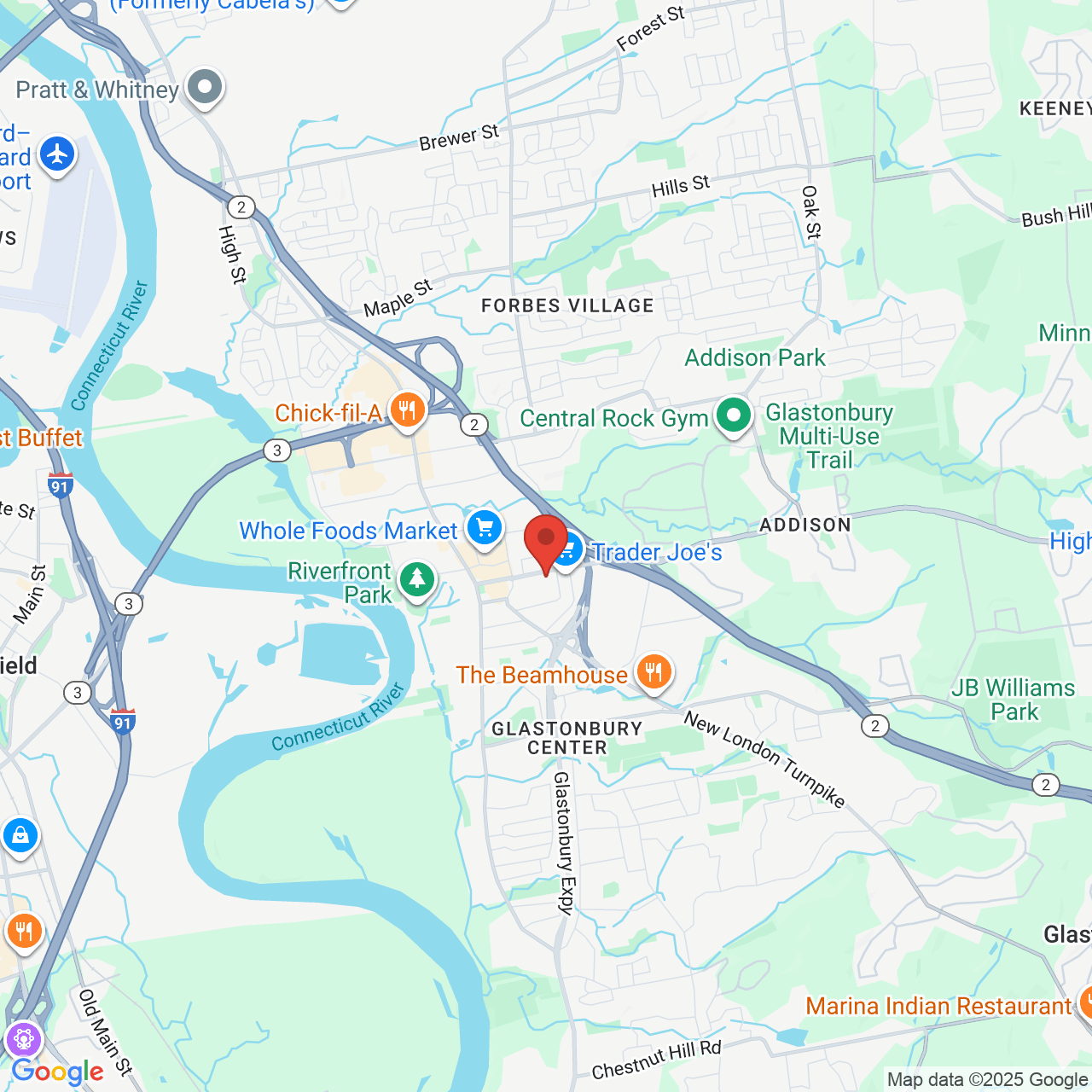
A board-certified prosthodontist is a dental specialist who completes three years of accredited residency training beyond dental school and passes rigorous written and clinical examinations administered by the American Board of Prosthodontics. This elite credential means the doctor has demonstrated mastery in surgical implant placement, bite mechanics, and full-mouth rehabilitation. Fewer than one in three prosthodontists achieve board certification. At Advanced Cosmetic and Implant Dentistry in Glastonbury, CT, Dr. Avinash Bidra and Dr. Xiao Chun Li are both board-certified prosthodontists providing complete All-on-4 care under one roof.
Schedule a consultation to find out if All-on-4 implants with a board-certified expert are right for you. Call (860) 578-9344 today.
Choosing a dental implant provider is one of the most consequential health decisions you will make. The All-on-4 procedure replaces an entire arch of missing teeth with just four strategically placed implants and a fixed hybrid bridge. When a general dentist or a corporate chain clinic performs this surgery, the risks are measurably higher. A board-certified prosthodontist brings a distinct set of qualifications that directly influence implant survival, aesthetic outcome, and long-term oral health.
A board-certified prosthodontist is a dentist who has completed three additional years of full-time residency training in prosthodontics — the specialty of dental restoration and replacement — and has passed the comprehensive certification process of the American Board of Prosthodontics. Only about one in three prosthodontists achieves this distinction. Board certification requires a written examination, a clinical examination, and submission of multiple treated patient cases demonstrating competency in complex restorative procedures.
A prosthodontist is a dental specialist who diagnoses, treats, and rehabilitates patients with missing or damaged teeth. These practitioners complete three years of accredited residency training after dental school, focusing exclusively on dental implants, crowns, bridges, full-mouth reconstruction, and occlusion (bite mechanics). While all prosthodontists complete this specialized training, only a subset pursue the additional credential of board certification.
The American Board of Prosthodontics (ABP) certification process is among the most demanding in dentistry. Candidates must first pass a comprehensive written examination covering implantology, biomaterials, occlusion, and orofacial pain. They then submit detailed documentation of 10-15 treated patient cases that demonstrate proficiency across the full scope of prosthodontic care. Finally, they undergo an oral clinical examination where they defend their treatment decisions before a panel of examiners. Certification is valid for eight years, after which diplomates must recertify to maintain their status. This rigorous process ensures that board-certified prosthodontists consistently deliver care at the highest standard.
All-on-4 dental implants demand precisely this level of training. The procedure requires three-dimensional planning of implant angulation, management of compromised bone volume, and simultaneous consideration of both surgical and prosthetic outcomes. A board-certified prosthodontist has demonstrated the ability to execute these complex cases successfully.
Prosthodontic residency programs require a minimum of 3,000 hours of supervised clinical instruction in restorative dentistry. Trainees master digital treatment planning, guided implant surgery, and the biomechanics of full-arch prosthesis design. This depth of preparation directly translates to better patient outcomes. A National Institutes of Health review confirms that surgeon experience is a significant predictor of implant survival, particularly in complex cases involving bone atrophy or compromised host sites.
Board-certified prosthodontists also stay current with evolving implant technology and biomaterials. They select from premium systems such as Nobel Biocare and Straumann, and they design prostheses that account for each patient's unique occlusal scheme, lip support, and smile line. This integration of surgical precision and prosthetic artistry is what distinguishes a specialist from a general practitioner.
The All-on-4 protocol uses two straight anterior implants and two tilted posterior implants to maximize contact with existing bone while avoiding critical structures such as the maxillary sinuses and inferior alveolar nerve. The posterior implants are placed at a precise 30- to 45-degree angle. An error of even a few degrees can compromise implant stability or cause nerve injury. Board-certified prosthodontists train for years to master these angulations and the associated prosthetic planning.
The All-on-4 technique, developed by Nobel Biocare, is a surgical and prosthetic system designed to rehabilitate the edentulous or即将 failing dentition with minimal morbidity. It uses four implants per arch — two straight and two tilted — to avoid anatomic obstacles and maximize bone-implant contact.
The All-on-4 technique, developed by Nobel Biocare, is a surgical and prosthetic system designed to rehabilitate the edentulous or即将 failing dentition with minimal morbidity. It uses four implants per arch — two straight and two tilted — to avoid anatomic obstacles and maximize bone-implant contact.
The tilted posterior implants are the defining technical feature of the All-on-4 protocol. By engaging cortical bone in the anterior maxilla or pterygoid region of the mandible, these tilted fixtures achieve primary stability even in patients with moderate bone loss. However, the angulation window is narrow. Deviations of more than five degrees from the planned trajectory can reduce implant-bone contact area, increase the risk of sinus perforation in the maxilla, or violate the inferior alveolar nerve in the mandible.
A board-certified prosthodontist uses cone-beam computed tomography (CBCT) and digital planning software to map every millimeter of the surgical field before making the first incision. This level of preoperative planning is not typical of general dentists who place implants sporadically.
Every patient presents a unique jaw morphology. Some have pneumatized sinuses that extend close to the alveolar ridge. Others have inferior alveolar nerves that course inferiorly in a low-lying loop. Patients with long-standing edentulism often present with knife-edge ridges that offer minimal bone width. These variations require adaptive surgical judgment that cannot be acquired from a weekend implant course.
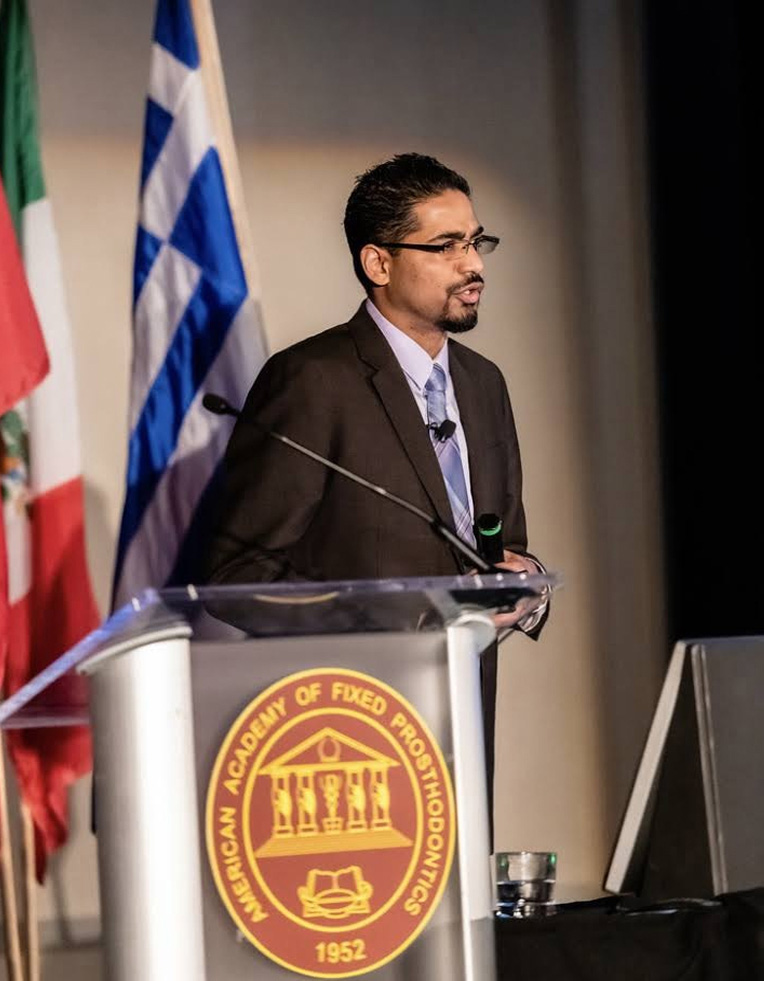
Dr. Avinash Bidra, a dual board-certified prosthodontist, has published extensively on managing these high-risk anatomies. He holds a U.S. patent for the Bidra Conversion Smart Polishing Cap, a device used in immediate-load All-on-4 protocols to refine the prosthetic fit during surgery. He serves as a Clinical Professor at the UConn School of Dental Medicine and has authored more than 100 peer-reviewed publications. Advanced Cosmetic and Implant Dentistry is one of only two Nobel Biocare All-on-4 Centers of Excellence in Connecticut, a designation that reflects consistently superior clinical outcomes.
The training differential between a general dentist and a board-certified prosthodontist is approximately 3,000 hours of dedicated residency instruction. General dentists may place implants after a weekend certification course. Board-certified prosthodontists complete three years of full-time specialty training focused exclusively on implant surgery, restorative materials, occlusion, and facial esthetics. This gap in preparation translates directly to differences in surgical precision, prosthetic quality, and complication rates.
When evaluating providers for full-arch implant treatment, the credential gap between a general dentist and a board-certified specialist is the single most important variable a patient can assess.
The Commission on Dental Accreditation (CODA) requires prosthodontic residency programs to deliver at least 36 months of full-time postdoctoral training. Programs must include a minimum of 350 implant placements under faculty supervision, exposure to advanced imaging, and comprehensive training in maxillofacial prosthetics for patients with acquired or congenital defects.
General dentists are not required to complete any postgraduate implant training before placing implants. The American Dental Association does not recognize implantology as a specialty, which means any licensed dentist can offer surgical implant placement regardless of training background. The clinical significance is substantial: a 2018 systematic review found that dentists with advanced surgical training achieved significantly higher implant survival rates in medically compromised patients.
| Qualification | General Dentist | Board-Certified Prosthodontist |
|---|---|---|
| Postdoctoral training | None required | 3 years (36 months) residency |
| Board certification | Not available in implantology | American Board of Prosthodontics |
| Implant-focused case volume | Sporadic, shared with general dentistry | Daily restorative and surgical focus |
| Complex case management | Limited exposure in training | Required competency for certification |
| Precision and outcomes | Variable, practice-dependent | Standardized, externally validated |
The All-on-4 procedure demands simultaneous mastery of surgery and prosthetics. The implants must be positioned not only for osseointegration but also to support a fixed prosthesis that provides adequate lip support, proper occlusal plane orientation, and natural tooth proportions. A board-certified prosthodontist is uniquely trained to manage both domains. When implants are placed by a provider who lacks this dual training, the prosthetic phase often requires compromises that affect the final aesthetic result. Common complications include visible metal margins through thin gingival tissue, overcontoured pontic sites that trap food debris, and occlusal prematurities that accelerate prosthetic wear.
Patients who begin treatment with a board-certified specialist avoid the most common failure pathway: the initial placement by an underqualified provider followed by expensive and painful revision. Revision surgery for failed All-on-4 implants is significantly more complex than primary placement, often requiring removal of integrated implants, bone grafting, and extended healing times.
All-on-4 implant failure typically results from improper implant angulation, inadequate primary stability, or prosthetic design errors. The consequences include nerve injury (persistent paresthesia), implant loosening or fracture, peri-implantitis, and catastrophic prosthetic failure. Revision surgery is significantly more complex and costly than primary placement, often requiring implant removal, bone grafting, and extended healing. Choosing a board-certified prosthodontist for the initial procedure is the most effective way to avoid these outcomes.
While All-on-4 has an excellent long-term track record when performed by qualified specialists, complication rates rise sharply when the procedure is performed by providers without advanced surgical training.
The most frequent technical failures in All-on-4 treatment involve the tilted posterior implants. When these implants are placed at an incorrect angle, they may lack sufficient bone-implant contact for osseointegration. The result is early implant mobility that necessitates removal. Nerve injury is another serious complication. The inferior alveolar nerve runs through the mandibular body, and if the most posterior implant violates this structure, the patient may experience permanent lip and chin numbness. According to published data, inferior alveolar nerve injury occurs in 0.4% to 5% of posterior mandibular implants, with rates highly dependent on surgeon experience.
Salvage of a failed full-arch restoration is substantially more involved than the primary surgery. The revision protocol typically proceeds as follows:
Many patients who experience All-on-4 failure are referred to Advanced Cosmetic and Implant Dentistry specifically for revision. Failed All-on-4 revision requires the same board-certified expertise that should have been present at the first surgery, but at a higher cost and with more limited bone stock.
Advanced Cosmetic and Implant Dentistry operates a one-doctor, one-office, one-day model for All-on-4 treatment. The same board-certified prosthodontist who performs the surgical placement also designs and delivers the final prosthesis. An on-site dental laboratory, IV sedation, and a spa-like setting complete the patient experience. This integrated approach eliminates the handoffs between separate providers that introduce errors and delays.
Many dental practices that offer All-on-4 treatment rely on external referral networks for surgical placement and separate dental laboratories for prosthetic fabrication. This fragmented model introduces communication gaps that can compromise outcomes.
At our Glastonbury office, the prosthodontist who performs your implant surgery also selects the prosthetic components, approves the laboratory work, and places the final restoration. This continuity is especially important in full-arch implantology, where the implant position and the prosthetic design must be in absolute harmony. A Nobel Biocare All-on-4 Center of Excellence designation requires adherence to strict clinical protocols that prioritize this integrated care model.
We recognize that full-arch implant treatment represents a significant investment of time and emotion. Our office is designed to minimize anxiety: private treatment rooms, warm blankets, noise-canceling headphones, and IV sedation administered by board-certified anesthesiologists are standard. The before and after photo gallery on our site documents the transformative results our patients achieve.
Advanced Cosmetic and Implant Dentistry is a non-corporate, family-owned prosthodontic specialty practice serving Glastonbury, Hartford, and all of Connecticut. Dr. Avinash Bidra and Dr. Xiao Chun Li are both board-certified prosthodontists. Dr. Bidra is a Clinical Professor at UConn School of Dental Medicine, a U.S. patent holder, and recipient of the Distinguished Clinician Award (2019) and Educator of the Year (2023). Dr. Li is one of the few female board-certified prosthodontists in Connecticut. The practice maintains over 270 patient reviews with a 4.9-star average.
Board certification is a voluntary credential that goes beyond state licensure. At Advanced Cosmetic and Implant Dentistry, both doctors have earned and maintained this distinction through the American Board of Prosthodontics' rigorous recertification process.
As a Clinical Professor and former Director of the Prosthodontics Residency at UConn School of Dental Medicine, Dr. Bidra has trained many of the prosthodontists practicing in the Northeast today. His U.S. patent for the Bidra Conversion Smart Polishing Cap is used internationally in immediate-load All-on-4 cases. He has received the American College of Prosthodontists' Distinguished Clinician Award (2019) and Educator of the Year Award (2023). Dr. Li earned her board certification through the same rigorous ABP process and brings additional expertise in complex restorative cases. Together, they represent the highest standard of prosthodontic care available in Connecticut.
If you are considering All-on-4 dental implants, contact our office to schedule a consultation with a board-certified prosthodontist who will evaluate your case personally and develop a treatment plan tailored to your anatomy and goals.
Approximately one in three prosthodontists achieves board certification through the American Board of Prosthodontics. The certification process requires passage of written and clinical examinations and submission of multiple treated patient cases, with recertification required every eight years.
At Advanced Cosmetic and Implant Dentistry, All-on-4 treatment starts at approximately $25,000 per arch. The starting price covers implant placement, premium components, and a provisional restoration. Financing through CareCredit, Cherry, and Proceed Finance is available to qualified patients.
Yes. The All-on-4 protocol uses tilted posterior implants to engage available bone and is often performed without bone grafting. For severe atrophy, Dr. Bidra can utilize pterygoid or zygomatic implants as alternative solutions.
Yes. IV sedation is administered by board-certified anesthesiologists for all All-on-4 procedures at our Glastonbury office. Patients remain comfortable throughout surgery with no memory of the procedure.
The Teeth-in-a-Day protocol allows patients to receive fixed temporary teeth on the same day as implant placement. After surgery, a custom bridge is attached to the implants, so patients leave with functional, aesthetic teeth immediately.
Choosing a provider for full-arch implant treatment is a decision that affects your oral health, appearance, and quality of life for decades. A board-certified prosthodontist brings the surgical training, prosthetic expertise, and clinical judgment that this complex procedure demands. At Advanced Cosmetic and Implant Dentistry, Dr. Avinash Bidra and Dr. Xiao Chun Li provide the complete All-on-4 protocol in a single Glastonbury office with a coordinated team and on-site laboratory.
Call (860) 578-9344 or contact us online to schedule your consultation. Discover how board-certified prosthodontic care can give you a smile that lasts.
Patients in Hartford, CT, can experience unmatched quality and value by choosing board-certified doctors Avinash Bidra and Xiao Chun Li.
We are affiliated with the following prestigious organizations: