
When people ask about teeth in a day cost, they are often comparing treatment plans that may include very different services. The phrase usually describes a same-day temporary set of teeth attached after implant placement, not a complete final restoration delivered in one day. Understanding each stage helps you compare estimates on the work they actually include.
For eligible patients, an implant-supported full-arch treatment may involve planning, implant surgery, and a temporary fixed bridge placed on or soon after surgery. The temporary restoration supports function and appearance while the implants heal. A definitive restoration is made later, after the clinical team has assessed healing and confirmed the next step.
The exact sequence depends on your examination and treatment plan. The term alone does not tell you how many implants are planned, what the temporary bridge is made from, whether extra procedures are needed, or what the final teeth will be. Review the practice’s All-on-4 treatment information to understand the service pathway, then ask how it applies to your case.
There is no responsible way to estimate a patient’s total from the phrase “teeth in a day” alone. Several components can change the scope and expense of care.
| Part of care | What it may cover | Questions to ask |
|---|---|---|
| Evaluation and planning | Clinical examination, imaging, digital planning, and discussion of options | Which records and planning steps are included? |
| Surgery | Implant placement and any planned supporting procedures | Are all surgical procedures listed separately? |
| Temporary teeth | A provisional bridge used during healing, with adjustments as needed | What material is used, and what visits or repairs are included? |
| Final restoration | Design and fabrication of the definitive prosthesis after healing | What material and design are proposed, and when is it delivered? |
| Follow-up | Postoperative checks, maintenance guidance, and care of the restoration | Which follow-up appointments are part of the estimate? |
Planning begins with understanding your oral health, goals, and anatomy. An evaluation may include an examination and imaging so the clinician can assess bone, remaining teeth, bite, and other factors relevant to implant placement. Findings may affect the number and position of implants or whether additional treatment should be considered.
Ask whether the estimate includes the diagnostic steps needed to create your plan. If you are comparing proposals, check that each is based on a comparable evaluation. A preliminary number given before examination may not reflect the treatment ultimately recommended. The dental implant cost information can help frame questions, but your own plan requires individual assessment.

The surgical portion depends on the plan and the patient’s clinical needs. The number of implants, the complexity of the case, and any additional procedures can affect what is involved. Do not assume that two plans with the same headline phrase include the same surgical work.
Ask the clinician to explain which procedures are recommended and why. If a plan includes a procedure beyond implant placement, ask how it changes the timeline, recovery, and total estimate. You can also review the practice’s implant treatment overview before your visit.
A temporary bridge is not simply a smaller version of the final restoration. It is used during healing, and the design may need adjustment as the patient adapts and the clinical team monitors progress. Material, construction, fit, and included adjustments can differ among treatment plans.
Ask what the temporary teeth are designed to do, how they will be maintained, and what to do if they feel loose or uncomfortable. Clarify whether adjustments and repairs during the healing period are included in the estimate or billed separately. The temporary phase is part of the treatment plan, not a detail to overlook while comparing totals.
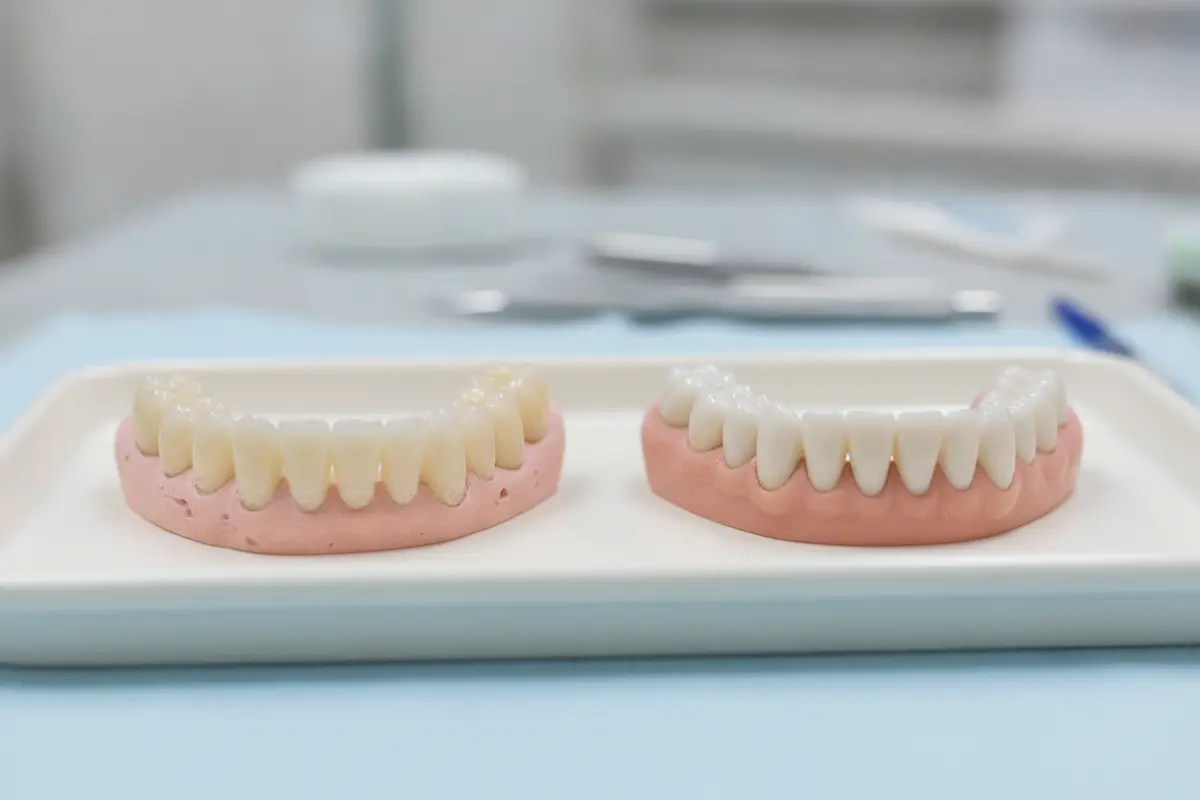
The definitive restoration is a major part of the overall plan. Materials and design can affect laboratory work, fabrication, fit, and maintenance considerations. A quote that only describes the day-of-surgery temporary teeth may not represent the complete treatment investment.
Ask for the proposed final material and design in writing. Confirm whether the estimate includes fabrication, delivery, and any planned transition from the temporary bridge. If several options are discussed, ask the clinician to explain the practical differences and why one may be appropriate for your needs. Avoid comparing only the headline price when the restorations differ in scope or material.
For background on full-arch treatment, see the practice’s full-mouth reconstruction overview. Your clinician can explain whether that broader approach is relevant to your case.
Implant treatment does not end when the temporary teeth are attached or the final restoration is delivered. Follow-up helps the care team check healing and address concerns. The exact schedule varies with the patient and treatment plan, so ask what appointments are expected and what they cost.
Do not assume that every estimate uses the same definition of follow-up. Ask for the scope and any exclusions in writing. The practice’s implant denture information offers another point of comparison when discussing restorative choices.
Request an itemized treatment plan and compare like with like. A useful comparison identifies what happens at each stage, what materials are planned, and what is included after surgery. If one proposal appears much lower, first check whether it leaves out the final restoration, imaging, extra procedures, or follow-up.
If financing is a consideration, ask what payment options may be available and which parts of the plan they apply to. The financing information is a starting point; confirm current terms directly with the practice and any financing provider.
Published examples can provide context, but they may describe a different treatment, location, or date. For example, the University of Illinois Chicago College of Dentistry discusses a range for crowns and other dental procedures in its article on the financial and well-being costs of poor oral health. That general information does not establish the price of a patient’s full-arch implant plan. Review the source in context at UIC College of Dentistry’s discussion of dental costs, and rely on an individualized written estimate for your own care.
Beyond the major stages, ask how the estimate handles the smaller details that can affect the experience and total. A written plan should make clear whether medications, sedation, temporary adjustments, and additional visits are included when applicable. It should also identify which items are estimates rather than fixed components, and what circumstances could lead the clinician to recommend a change.
It can help to divide the proposed care into phases: before surgery, the procedure day, the healing period, and delivery of the final restoration. Ask when payments are due in relation to each phase. This does not predict the final amount; it helps you understand what you are being asked to plan for and when. If a plan is revised after examination or healing, ask for an updated written explanation before agreeing to the next step.
Patients may also want to clarify who coordinates each stage. At a practice with an in-house laboratory, planning and restoration work may be coordinated within the same care setting; ask what that means for your particular case rather than assuming every task or visit is included. The practice’s practice overview and doctor profiles can provide background before you discuss the plan.
Price is only one part of a comparison. A plan is easier to evaluate when you know what each stage is intended to accomplish, how the team will review progress, and what options exist if the initial plan needs to change. This is not a reason to choose a more expensive plan automatically. It is a reason to understand what you are receiving before comparing totals.
For example, an estimate might list a temporary bridge but not explain whether it is designed for a short transition, how it is adjusted, or what support is available during healing. Another proposal might separate those services into different line items. Ask each provider to explain the same categories. The clearer the scope, the easier it is to see whether a difference in total reflects a meaningful difference in care, a different restoration, or simply a different way of presenting the estimate.
Also consider whether the treatment plan addresses your priorities. Some patients focus on timing, others on the feel and appearance of the temporary teeth, and others on the design and maintenance of the final restoration. Share those priorities with the clinician and ask how they fit within the clinical recommendations. An individualized discussion is more useful than assuming a single package suits everyone.
A little preparation can make the cost conversation more productive. Bring any existing treatment plans or estimates, along with a list of questions and priorities. If you have dental insurance, ask the plan administrator what information they need to review benefits; coverage determinations are separate from the clinical recommendation and may depend on your specific plan.
After the discussion, take time to read the plan. If two estimates use different labels, ask the offices to explain them in plain language. Do not feel that you must compare based on a single headline amount. A careful review of scope, stages, and exclusions gives you a more useful basis for a decision.
Even a detailed estimate can leave room for interpretation if it does not define what is excluded. Ask whether additional procedures are included only if they are identified during the evaluation, and how the office will discuss a change before proceeding. Clarify how the treatment plan handles an unexpected need during surgery, a temporary restoration that needs adjustment, or a healing period that calls for another check.
Ask whether maintenance visits are part of the initial treatment estimate or are considered ongoing care. Find out whether repairs, replacement parts, and future restoration work have separate fees. These questions are not predictions that a problem will occur. They help set clear expectations about what the quoted treatment covers and what would be discussed separately if circumstances change.
When you compare written proposals, keep the documents together and note the date, planned treatment, and any assumptions. If a proposal is revised, use the newest version and ask what changed. That simple record can prevent confusion when you discuss options with a clinician or revisit the decision later.
Usually, the phrase refers to a temporary restoration placed on or soon after implant surgery for appropriate candidates. The final restoration is typically planned for a later stage after healing and clinical assessment.
An estimate before examination may be preliminary. Imaging and a clinical assessment help determine what procedures and restorations are appropriate, so ask what the initial estimate includes and what could change it.
They may include different evaluation, surgical work, temporary materials, definitive restorations, or follow-up. Compare itemized scope and exclusions rather than the headline amount alone.
Ask whether it is included, what it is made from, and whether adjustments or repairs during healing are included. The estimate should make clear which stages and services are covered.
A personalized consultation can clarify which stages apply to you and what a complete estimate includes. Bring your questions about surgery, temporary teeth, the final restoration, and follow-up so you can compare options with a clear understanding of the plan.
Before that discussion, consider writing down what matters most to you. One person may want to understand how the temporary teeth will be adjusted; another may need to plan around work, travel, or payment timing. Naming those priorities helps the clinician explain how the proposed stages relate to your circumstances and which details still require examination. It also makes it easier to distinguish a clinical recommendation from a preference about scheduling or materials.
Ask the office to explain any unfamiliar line item before you sign or make a payment. You can ask what service it represents, when it occurs, and whether it is included in the total shown. If a procedure is conditional, ask what finding would make it necessary and how you would be informed of a change. Clear answers help you understand the estimate without treating an early figure as a guarantee.
Finally, make sure your copy reflects the plan you discussed. Check that the proposed arch, temporary restoration, definitive teeth, and expected follow-up are identified. If you are reviewing more than one proposal, compare the same stages and note what remains uncertain. A well-explained estimate is not only a number; it is a description of the care being considered and the questions that still need individual answers.
Patients in Hartford, CT, can experience unmatched quality and value by choosing board-certified doctors Avinash Bidra and Xiao Chun Li.
We are affiliated with the following prestigious organizations: