If you have spent any time on social media lately, you have probably seen the term “FP-1” attached to before-and-after smiles that look almost impossibly natural. Patients ask me about it in the office nearly every week now, usually alongside the option they have heard about for years: All-on-4. Both are excellent, well-established ways to replace a full arch of teeth with fixed, non-removable implants, and both can be life-changing. They are not, however, interchangeable. The one that is right for you comes down to your anatomy, not a trend. My goal here is to explain the real differences, clearly and without bias, so you can walk into a consultation already understanding the language.
The Basics
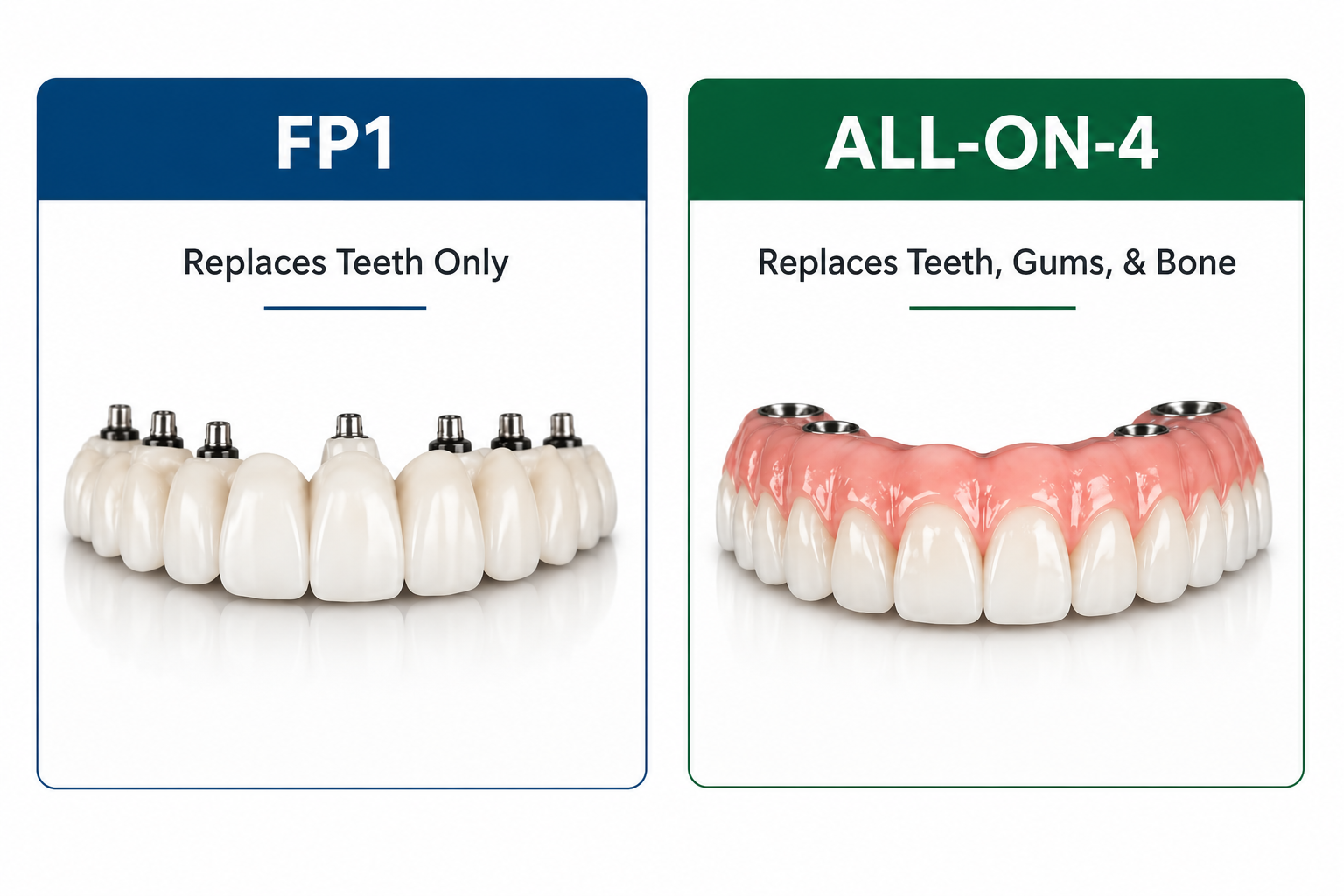
“FP-1” comes from a classification system prosthodontists use to describe fixed implant restorations. An FP-1 prosthesis replaces only the crowns of your teeth (the white part you see when you smile), and nothing else. There is no artificial pink gum material. The teeth are designed to appear as though they emerge directly from your own natural gum line, which is why FP-1 can produce the most seamless, natural-looking result of any full-arch option when the conditions are right. To achieve that look, an FP-1 case typically relies on a greater number of implants, often six to eight or more per arch, and it is usually crafted from full-contour zirconia for strength and a lifelike appearance. It is a beautiful solution, and it is also a demanding one, because every millimeter of tooth and gum has to already be in the right place.
The Basics
All-on-4 refers to a surgical technique that supports a full arch of fixed teeth on as few as four strategically angled implants. Because the rear implants are tilted to take advantage of denser available bone, All-on-4 can often be performed without bone grafting, and in many cases we can place the implants and attach a fixed set of teeth on the same day. The final restoration is most often a hybrid prosthesis (classified FP-3) that replaces both the teeth and a small amount of gum tissue using tooth- and gum-colored materials. That gum portion is not a compromise; it is a design feature. It restores lip and cheek support, fills in areas where natural bone and gum have receded, and creates a full, youthful smile in situations where rebuilding that tissue with the body alone would not be predictable. All-on-4 is one of the most thoroughly documented full-arch solutions in modern dentistry, with decades of clinical evidence behind it.
Side by Side
Clinical Qualification
This is where the two options genuinely diverge, and it is the part I want patients to understand most. An FP-1 restoration only works when your existing anatomy can support a natural tooth-to-gum transition on its own. Strong candidates generally have minimal bone and gum loss, stable and well-positioned soft tissue, a bite that has held its vertical dimension over time, and enough space to build the restoration in zirconia at a safe thickness. Your smile line matters too: a high smile line, which shows more gum, makes any imperfection in the transition zone visible and raises the aesthetic difficulty considerably. Because of the higher bite forces and tighter space in the lower jaw, FP-1 is generally most predictable in the upper arch.
All-on-4 opens the door for a much wider range of patients, including many who would not qualify for FP-1 at all. If you have experienced significant bone loss, have been in dentures for years, or want to avoid extensive grafting and a long treatment timeline, All-on-4 is often the more predictable and durable path. The gum-colored portion of the prosthesis does the work that your own receded tissue no longer can, and the tilted-implant design lets us build a stable foundation even when bone volume is limited. For patients who value a fixed result, fewer surgical steps, and a well-proven track record, it is frequently the ideal choice.
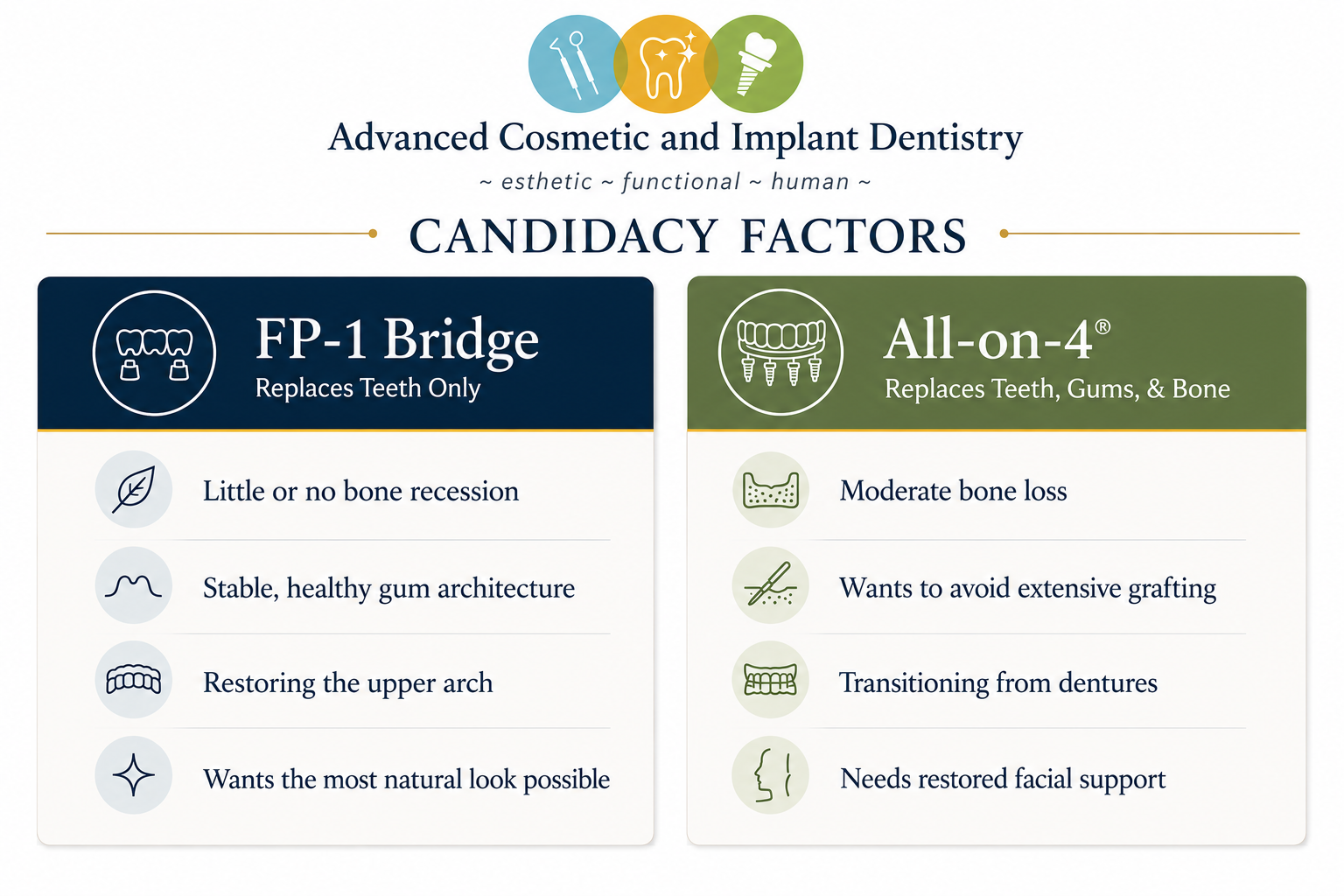
Neither option is “better” in the abstract. FP-1 can look more natural in ideal anatomy; All-on-4 is more forgiving and adaptable for the majority of real-world cases. The right answer is simply the one your mouth is built for.
Beyond the Trend
Some of the enthusiasm around FP-1 online frames it as automatically superior because it avoids “fake gums.” I understand the appeal, and in the right patient the result truly is remarkable. But it is important to know that forcing an FP-1 design onto a mouth that has lost bone or gum tissue can lead to teeth that look too long, uneven papillae, thinner and more fracture-prone prosthetics, and a result that is harder to keep clean and maintain over time. In those cases, the gum-colored material in an All-on-4 hybrid is not hiding a shortcut; it is the very thing that restores balance, support, and long-term health. Choosing well requires 3D CBCT imaging, a careful bite and facial analysis, and prosthetically driven planning done before any surgery. That is exactly the kind of comprehensive evaluation we do here, and it is the only honest way to know which solution fits you.
If you are weighing full-arch dental implants and want a straight answer about which approach suits your anatomy and your goals, the best next step is a consultation with proper imaging. You deserve a recommendation based on your mouth, not a headline.
Schedule a consultation with 3D imaging and a personalized full-arch treatment plan.
Or call us today at (860) 659-8660
Patients in Hartford, CT, can experience unmatched quality and value by choosing board-certified doctors Avinash Bidra and Xiao Chun Li.
We are affiliated with the following prestigious organizations: