

The number most people find online is somewhere between $25,000 and $50,000 per arch. I want to explain that price range and why the provider you choose is the most consequential financial decision of the whole process.
All-on-4 is one of the most complex procedures in dentistry. Done well, it lasts decades. Done poorly, it can cost you far more to fix than it would have cost to do it right. Understanding the cost structure isn’t just useful budgeting information. It’s how you protect yourself from making a $30,000 mistake.
The Short Answer
What All-on-4 Typically Costs
At our practice in Glastonbury, All-on-4 dental implants start at $25,000 per arch for premium-quality implants and biomaterials. Full-mouth restoration, both upper and lower arches, starts at $50,000.
But why such a wide range across providers? Because not all All-on-4 is created equal. What’s inside the number, including the implant brand, the materials, the lab, and the surgeon’s training, varies enormously. That variation is worth understanding before you schedule a consultation anywhere.
Breaking It Down
What Drives the Cost of All-on-4
Every All-on-4 treatment plan is custom. These are the factors that move the number up or down:
| 1 | Number of arches treated
Upper and lower are priced separately. Some patients only need one arch restored; others need both. Your surgeon will determine this during your evaluation using 3D imaging of your jaw. |
| 2 | Implant brand and quality of materials
There’s a meaningful difference between premium implants from Nobel Biocare or Straumann and lower-cost alternatives. Budget practices often don’t disclose which implant system they’re using. We only use premium-grade components because inferior materials increase the long-term risk of failure, and failure means starting over. |
| 3 | The bridge material
Full-arch bridges are made from acrylic, zirconia, or hybrid composites. Monolithic zirconia offers the best durability and most natural look. It’s also what we use. Cost varies by material and fabrication complexity. |
| 4 | Whether bone grafting is required
All-on-4 was engineered to reduce or eliminate the need for bone grafts. By angling the posterior implants, your surgeon maximizes contact with available bone, even in areas where density has declined. In most cases, grafting isn’t necessary. In some, it is. |
| 5 | Sedation and anesthesia
IV sedation is available for patients who prefer a relaxed, semi-conscious experience. It’s administered by a skilled dental anesthesiologist and priced separately from the surgical fee. |
| 6 | In-house lab versus outsourced fabrication
Practices with in-house dental labs have direct control over the design and quality of your restoration. Our practice maintains an in-house lab, which allows me to personally oversee every stage of your custom restoration. |
| 7 | The surgeon’s training and case volume
This is the one most patients don’t think to ask about, and the one that matters most. See below. |
What Most Articles Don’t Tell You
The Part No One Talks About: Provider Credentials
All-on-4 is not a regulated procedure in terms of who can perform it. Any licensed dentist can legally offer it. That means a dentist with two days of training and one who has placed thousands of cases are both allowed to call themselves All-on-4 providers.
The skill gap between those two providers is enormous. And the consequences of that gap, on a procedure that costs $25,000 or more, can be financially and physically devastating.
“The right question isn’t ‘what is the cheapest All-on-4?’ It’s ‘who is the most qualified surgeon I can find, and can I afford to work with them?’”
At the specialist level, the relevant credential is a prosthodontist: a dentist who completed an additional three-year residency specifically focused on implants, restorative dentistry, and full-mouth reconstruction. Beyond that, board certification by the American Board of Prosthodontics represents the highest clinical standard in the specialty.
Dr. Avinash S. Bidra’s Credentials
- →Board-certified prosthodontist and sub-specialist in Oral and Maxillofacial Prosthodontics
- →One of the few board-certified prosthodontists in Connecticut
- →Two-time Nobel Biocare All-on-4 Center of Excellence: one of only two practices in CT to earn this recognition
- →2023 Educator of the Year Award, American College of Prosthodontists
- →2019 Distinguished Clinician Award, American College of Prosthodontists
- →Director, Postgraduate Prosthodontics Residency at UConn School of Dental Medicine
- →Trains dentists and prosthodontists across the United States
- →U.S. patent holder for an innovation in full-arch dental implant design, commercially available nationwide
- →Published researcher in internationally peer-reviewed dental science journals
- →Has placed thousands of dental implants in Hartford, CT, and beyond
This matters to your cost calculation. A surgeon at this level has seen more edge cases, managed more complications, and refined more surgical protocols than the vast majority of providers offering All-on-4. The risk of revision surgery, which can cost as much as the original procedure, drops significantly when the placement is done correctly the first time.
Paying for Treatment
Does Insurance Cover All-on-4?
Most dental insurance plans don’t cover All-on-4 implants in full, but coverage is more common than many patients expect. Some plans cover a portion of the cost, typically for medically necessary extraction, sedation, or specific components of the procedure.
Our team will help you file a reimbursement claim with your insurance provider for every applicable stage of treatment. For out-of-pocket costs, we accept financing through CareCredit, Proceed Finance, and Cherry, three of the most trusted third-party lenders in healthcare.
A Common Question
What About All-on-6: Is That Different?
You may come across the terms All-on-6 or All-on-X. The concept is identical: a full arch of fixed, implant-supported teeth. The number refers to how many implants are used per arch. Some patients’ anatomy calls for five or six implants rather than four. In those cases, your surgeon will recommend the approach that’s right for your jaw, not a one-size-fits-all protocol.
The number of implants does affect cost. A treatment plan using six implants per arch will carry a higher fee than one using four. Your surgeon will explain the reasoning during your evaluation.
A closer look at how the All-on-X procedure works, and what makes it a different category of care than traditional implants or dentures.
The Math That Matters
The Real Cost of Choosing the Wrong Provider
A meaningful portion of the work I do is fixing All-on-4 cases that other providers placed incorrectly. Patients come to me after spending tens of thousands of dollars elsewhere, only to find out their implants were poorly positioned, their bridges were ill-fitting, or the materials they were sold weren’t what they thought they were paying for. By the time they sit down in my chair, the conversation isn’t about saving money anymore. It’s about salvaging what they have left.
That’s the part of the All-on-4 economy most patients never see. The least expensive quote you find is not necessarily the best financial decision. If a lower-cost treatment fails, due to poor implant placement, inferior materials, or insufficient surgical experience, the cost to remove, revise, and replace can equal or exceed the original procedure. You could spend $18,000 then another $25,000 fixing it, ending up at $43,000 for a result you could have had for $25,000 done right the first time.
Beyond the financial exposure, failed implants carry real physical consequences: bone loss, gum recession, and months of additional recovery. Revision cases are also harder than original cases. The bone has been compromised, the soft tissue has scarred, and I have to work around someone else’s mistakes rather than starting with a clean foundation.
The framework that protects you is simple. Ask these questions of any provider you’re considering:
| → | What is your training and specialty?
Are you a general dentist or a board-certified prosthodontist? How many years of residency did you complete in implants and restorative dentistry? |
| → | How many All-on-4 cases have you placed?
Case volume is a proxy for experience. Hundreds or thousands of cases produce a different surgeon than dozens. |
| → | What implant brand and bridge material are you using?
Any reputable provider will answer this directly. If the answer is vague, that tells you something. |
| → | Is your lab in-house or outsourced?
In-house fabrication means your surgeon controls the quality of the final restoration. Outsourced means they don’t. |
A Real Patient Story
From Failing Teeth to a Full Smile in One Day
 Before
|
 After
|
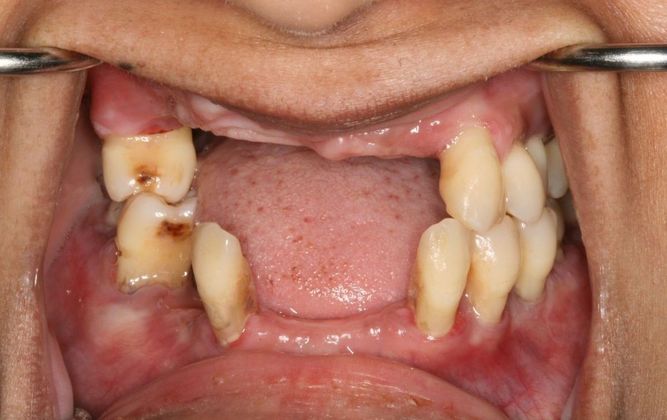
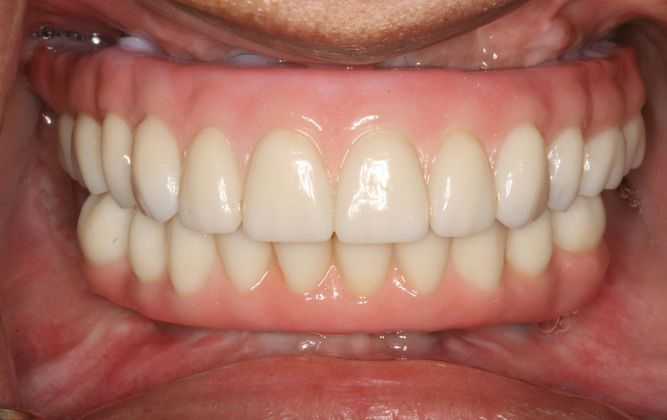
This patient was a young engineer dealing with gum disease and soft bone, and she had been losing one tooth after another for years. Frustrated with her removable partials and trying to hold on to her last natural teeth at all costs, she came to our practice hoping there was a way to avoid dentures altogether.
My evaluation showed she was a strong candidate for full-arch implant treatment. Her plan included extractions, All-on-4 implant placement in both arches with same-day “teeth in a day” delivery, and a final full-mouth reconstruction using monolithic zirconia bridges. Despite her bone quality concerns, no bone grafting was necessary. The angled posterior implants used in the All-on-4 protocol made full use of the bone she did have.
The result is what you see above: a stable, fixed, beautiful full-mouth restoration delivered without the long timelines, the staged surgeries, or the dentures she had spent years trying to avoid.
Next Steps
Ready to Get Accurate Numbers for Your Case?
Online price ranges are a starting point, not a quote. Your actual cost depends on your jaw structure, bone density, how many arches need treatment, and the specific materials and approach your surgeon recommends. The only way to know what you’ll pay is to sit down with a qualified provider who has evaluated your 3D imaging.
We offer thorough consultations: a detailed review of your medical and dental history, 3D imaging of your oral structures, and a clear explanation of the treatment plan and what you can expect to pay. No vague estimates, no pressure.
Schedule Your All-on-4 Consultation
Find out what your treatment would involve, and what it would cost.